- Home
- AI travel agents
- Why Corporate Travel is Broken in 2026: AI is Fixing It
Why Corporate Travel is Broken in 2026: AI is Fixing It
- May 29, 2026
- XequenceAI
- AI travel agents, AI travel assistant, Artificial Intelligence
Why Corporate Travel is Broken in 2026: AI is Fixing It
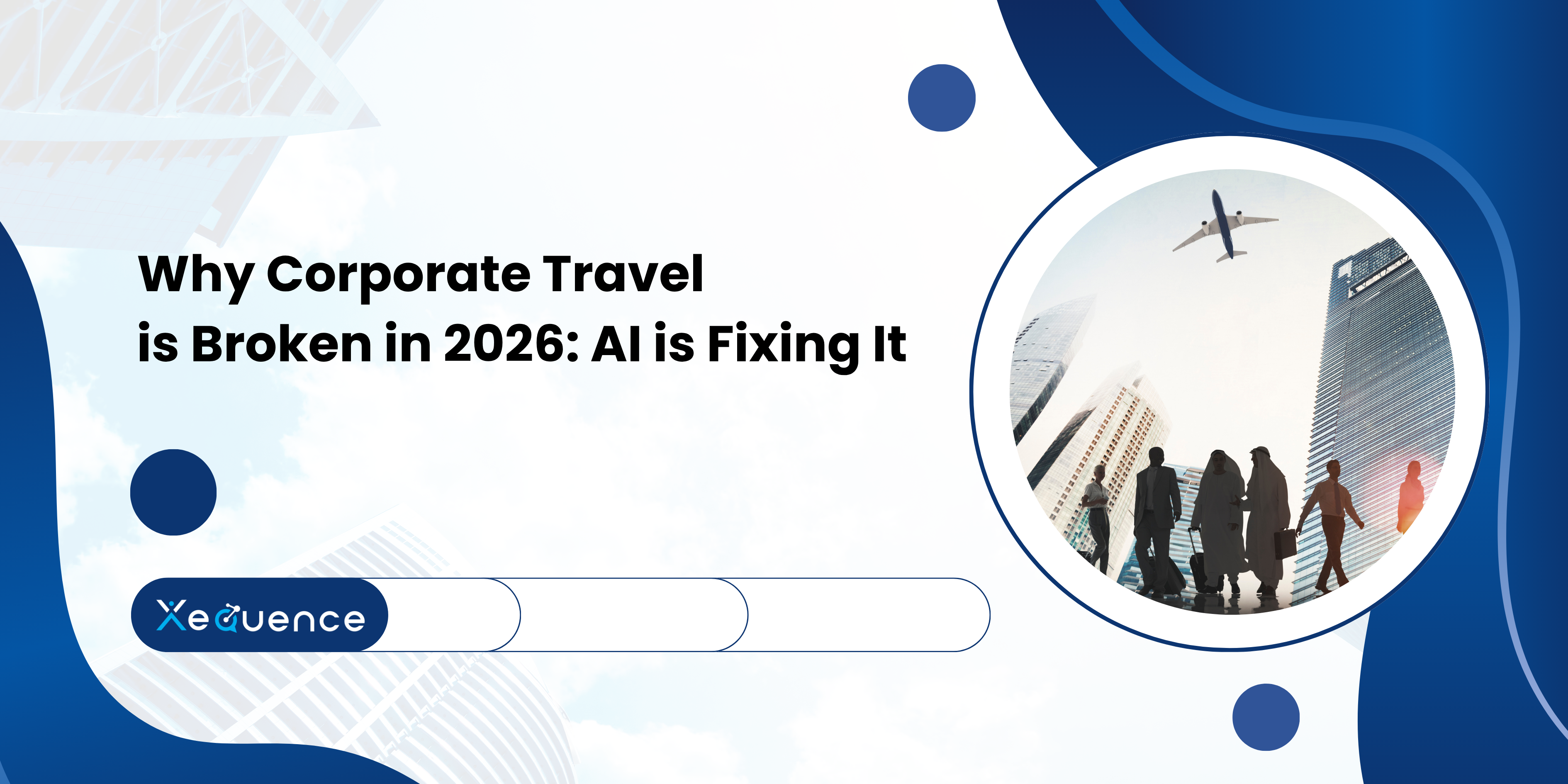
Corporate travel didn’t break overnight. It cracked slowly. Firms spend billions moving people across the world while still delivering the experience of patchwork, with spreadsheets, email threads, and policies nobody enjoys. Finance departments want more controls, while employees demand flexibility. Travel managers are caught in the middle, delivering tools that create friction at every turn. And now AI arrives and shows exactly how old-school it all was.
The Booking Experience Still Feels Like a Corporate Punishment
A sales director needs to visit three cities in four days. The booking platform suggests flights with impossible layovers, hotels twenty minutes from the meeting, and red-eye returns that guarantee burnout by Friday.
So what happens? The employee ignores the approved system and books elsewhere. Travel leakage continues to increase as most corporate travel management tools focus on compliance, not the individual traveler, and are set up to manage policy rather than the traveler. They consider the traveler as a line item, not someone with a calendar, habits, and constraints. AI changes the equation because it knows what the rules are for a modern AI-driven platform and can recognize patterns instantly.
- Which flights employees consistently avoid
- Which hotel locations reduce late arrivals
- Which travel choices correlate with fewer cancellations and lower expense claims
That matters because corporate travelers don’t rebel against policy for fun. They rebel because the experience feels irrational. The old model says: “Here are your cheapest options.” AI says: “Here’s the smartest option that balances cost, comfort, timing, and policy.” That difference sounds subtle. It isn’t.
Travel Managers Drown in Administrative Noise
Most travel managers never signed up to become full-time exception handlers. Yet that’s the job now. A traveler needs approval at midnight because a meeting changed. Another employee missed a connection. Finance flagged duplicate expenses. A regional policy changed without warning. Someone booked outside the platform again. The work never stops because traditional systems rely on humans to patch operational gaps manually.
AI removes entire layers of repetitive coordination
Rather than seeking control through approvals, travel managers can program policy decisions based on spend limits, client profiles, time sensitivity, and risk cues. Rather than dissecting abnormal expense reports, intelligent systems can flag irregularities in real time. Rather than responding to frustrated travelers, disruptions can be circumvented in real time and save money.
The biggest shift isn’t speed. It’s cognitive relief
Corporate travel has overloaded smart people with low-value work for years. AI finally strips away the administrative drag that burns teams out.
Cost Control Has Become a Losing Battle
Travel expenditures increased rapidly over the past few years. Rising fare volatility, oscillating hotel prices, fragmented suppliers, and austerity made planning purely a shot in the dark. Companies responded the usual way with stricter policies, more approvals & lower spending caps. Employees responded predictably with lower compliance, more frustration, and more off-platform bookings.
The harder companies squeeze, the messier travel becomes
AI approaches cost control differently because it reacts dynamically instead of relying on static policy rules written six months ago. Imagine a system that notices:
- A traveler consistently books late because approvals stall
- Certain routes spike in price every Tuesday afternoon
- One department overspends due to avoidable schedule patterns
- Travelers extend trips because return flights create unnecessary fatigue
This is the harsh reality many of today‘s organizations have to contend with: poor business travel experiences have their own financial implications. Burnout, lost efficiency, missed deadlines, and employee turnover don‘t usually figure in travel costs, but they impact the business nonetheless.
Sustainability Reporting Became a Corporate Headache
Executives talk about sustainable travel constantly. Most companies still struggle to measure it properly. The data lives everywhere like for example in Airline systems, Expense platforms, Vendor portals, Carbon tracking tools and Procurement software. Travel managers often spend more time assembling sustainability reports than improving travel programs themselves. Employees notice the contradiction too. Companies push environmental objectives while herding travelers through inefficient itineraries, adding both emissions and fatigue.
AI bridges that by bringing sustainability into the game in real-time rather than in post-mortem reporting. A more intelligent system could suggest lower emission routes by default, highlight inefficient traveling patterns, and weigh sustainability objectives against passenger comfort and business urgency. That last part matters. Employees no longer accept sustainability theater. They expect practical decisions that align with reality.
Employees Expect Consumer-Grade Experiences Everywhere
This might be the biggest reason corporate travel feels broken. People use intelligent apps all day long. Their music app predicts moods better than some managers understand workloads. Their shopping platforms personalize everything instantly. Their navigation apps reroute in seconds. Then they open a corporate travel tool and feel transported back to 2014. The gap has become impossible to ignore. Employees now expect travel systems to behave like modern technology:
- Predictive
- Conversational
- Adaptive
- Personalized
- Immediate
AI provides this expectation naturally as it interacts more like an assistant rather than a database. Rather than leading travelers down strict workflows, AI can respond to inquiries on the spot, assemble itineraries through conversation, offer instant alternatives, and mitigate disruptions before the panic reaches a Slack channel or an airport concourse.
That doesn’t just improve convenience. It rebuilds trust in managed travel programs.
Conclusion
Why isn‘t corporate travel broken? It‘s not because people have started to hate business travel. Your teams still need in person meetings, client relationships and in person collaboration. The system broke because employee expectations evolved while corporate travel technology stayed frozen in operational bureaucracy. AI didn’t create the frustration. It revealed how much friction companies had normalized for years.
Now the industry faces a choice. Keep layering new policies onto outdated systems. Or rebuild corporate travel around intelligence, adaptability, and actual human behavior. The companies that move first won’t just save money. They will create travel programs employees stop trying to escape.
Recent Posts
The Rise of Autonomous Coordination Infrastructure: Powering the Future of AI
Rajib Kar
July 10, 2026
Newsletter
Get regular updates on data science, artificial intelligence, machine
You may also like

What Happens When AI Agents Start Working Together?
XequenceAI
July 27, 2026

The Blueprint of Autonomous Operations
Rajib Kar
July 16, 2026
The Rise of Autonomous Coordination Infrastructure: Powering the Future of AI
Rajib Kar
July 10, 2026
Single AI vs. Multi-Agent AI: A Complete Enterprise Guide
Suraj Kumar
July 8, 2026