- Home
- Artificial Intelligence
- Enterprise Operations & Data Silos: The AI Solution for 2026
Enterprise Operations & Data Silos: The AI Solution for 2026
- June 25, 2026
- XequenceAI
- Artificial Intelligence, Business, Technology
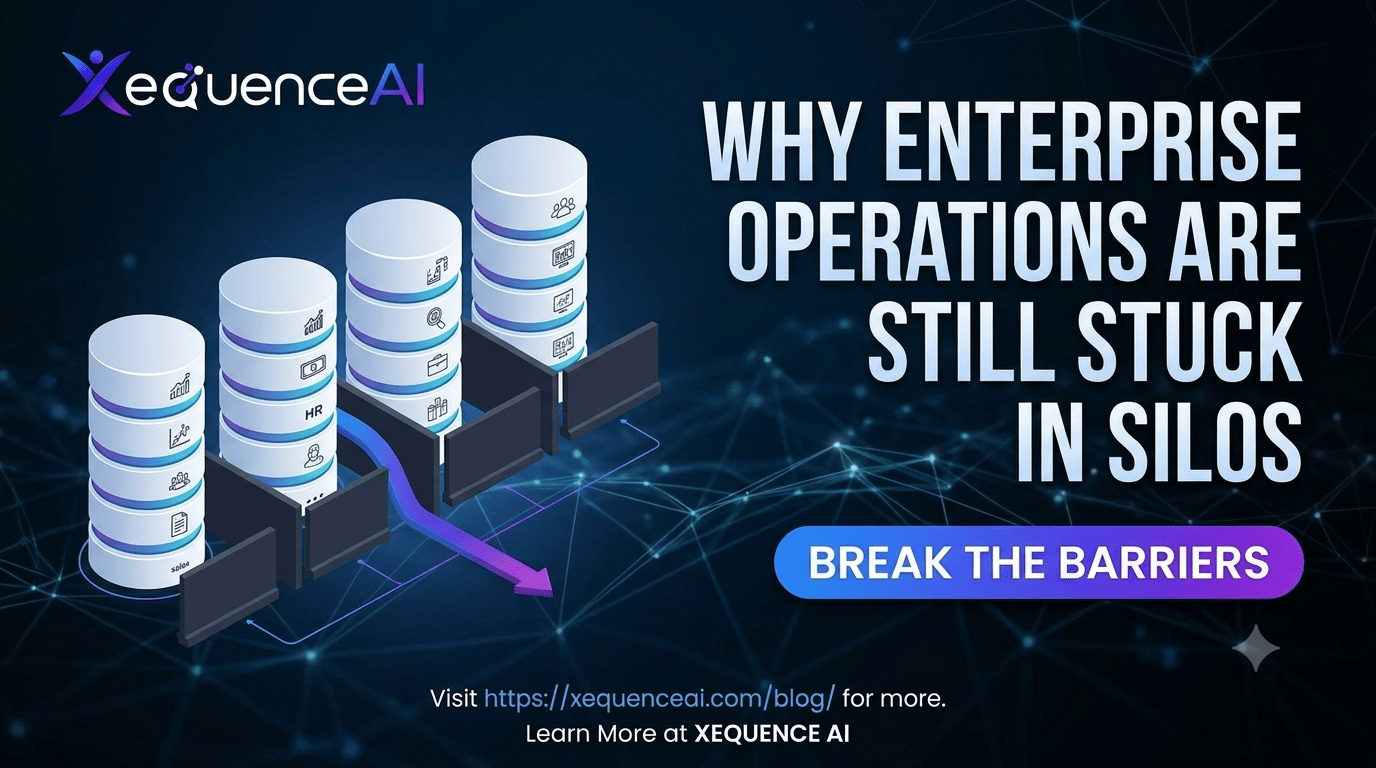
Surprisingly, few companies function as one connected unit, even after spending big on ongoing digital. Even with tools like shared workspaces online and programs that link tasks together, teams still often act like they are miles apart. Legacy systems dragging behind, mixed-up priorities across teams, and routines carved deep over years, along with how people really think and act that mix turns basic tasks into mazes of delays. Every enterprise inherits technology decisions from previous decades. Systems that were originally designed to solve isolated departmental problems gradually evolve into rigid operational boundaries. Finance optimizes for financial accuracy, Human Resources protects employee records, Sales prioritizes pipeline visibility, and Operations manages execution. Each platform becomes exceptionally effective within its own domain while becoming increasingly disconnected from everything around it.
Legacy Systems: When Yesterday’s Architecture Dictates Today’s Decisions
This fragmentation creates administrative drag that employees experience every day. Spreadsheets get fixed by hand when team members act like couriers for facts stuck in separate systems. Working across departments feels pointless because tools push people back into silos. Routine jobs take longer since matching entries eats up time meant for real work. The consequences become visible across every operational layer:
- Information exists in multiple systems with conflicting versions of reality.
- Employees repeatedly enter identical data across disconnected applications.
- Approval processes slow because every department maintains separate ownership rules.
- Decision-makers spend more time validating reports than acting upon them.
Organizational Psychology: Why Silos Feel Safer Than Collaboration
What keep operations split isn’t just tools or systems. How people act matters just as much. Units tend to grow their own ways of seeing things like different words, goals, what they value. Slowly, those habits turn into walls.
The psychological impact extends beyond leadership. Out of habit, workers start chasing permission rather than answers. Problem-solving fades as rule-following takes over, and teamwork slowly seems more like a burden than forward motion. Each time tasks get passed by hand, doubt creeps in and then that doubt spawns yet another level of oversight. The organization slowly accumulates operational noise that no individual intentionally designed but everyone is forced to navigate.
Misaligned KPIs: When Success in One Department Creates Failure in Another
Perhaps the most underestimated driver of enterprise silos is the measurement system itself. Organizations frequently reward departmental optimization while expecting enterprise-wide collaboration. These objectives rarely coexist peacefully. A procurement team focused exclusively on cost reduction may unintentionally slow production. Sales teams rewarded solely for revenue growth may introduce operational complexity that service teams cannot efficiently support. Finance may prioritize quarterly efficiency while product teams require long-term investment. Each department succeeds according to its own scorecard while the organization collectively loses momentum. The structural contradiction becomes increasingly obvious:
- Individual departments optimize for local efficiency.
- Enterprise leaders expect cross-functional agility.
- Employees receive conflicting priorities from different management layers.
- Collaboration becomes optional because incentives rarely reward shared outcomes.
This disconnect transforms collaboration into negotiation. Every project requires departments to reconcile competing objectives before meaningful work can even begin. Administrative coordination becomes an invisible tax imposed on every strategic initiative.
Administrative Noise and the Hidden Cost of Fragmented Workflows
Old company routines followed a straight path, step by step. One team passed details to the next after sign-offs, paperwork stacking up along the way. These methods brought control—built on the quiet belief that nothing much would shift during the process.
Things run differently now in companies. What customers want changes fast, where goods come from keeps moving, while signs about markets show up instantly. Even so, plenty of teams still rely on ways of working built for calmer times, when change comes slow.
Workers find themselves stuck—outside everything shifts fast while inside nothing seems to budge. Instead of fixing what customers face, more hours slip away chasing down data, waiting on status reports, patching mismatched details, or handling odd cases that never fit the mold. This administrative noise quietly consumes organizational capacity. What slows work isn’t skill—it’s mental effort spent on clumsy systems rather than useful output. The real cost hides in plain sight: time burned just to keep things running.
Integrated Operational Frameworks: Delivering Cognitive Relief Instead of More Complexity
Modern operational frameworks represent more than another technology upgrade. What do they do best? It lightens mental load throughout the company. Instead of making staff adjusts to broken tools, smooth platforms now bend themselves around how people actually get things done. One big system keeps facts straight, so nobody argues over which number is right. Machines handle boring paperwork now, freeing up time for work that needs human thought. When teams share tools, their goals tend to line up without extra meetings or emails. What used to be separate reports become parts of one clear picture. Silos fade when everyone sees the same dashboard.
The transformation extends beyond efficiency gains. It changes how employees experience work. When people do not have to recall where files sit or trace old steps for sign-offs, mental space opens up thanks to tools that feel familiar and smooth. Quick access to correct information speeds up decisions. As collaboration blends into routine work, it stops seeming forced. Knowledge within teams flows smoothly, without sudden jumps.
Conclusion: Breaking Silos Requires Rebuilding Both Systems and Mindsets
Deep inside, habits stick because they’ve been repeated so many times. When approval drags on, progress halts—everyone notices the delay, yet nothing shifts. Each system draws its own line in the sand, yet goals rarely match across units. One group wins, another loses—still no one connects the dots. Fixing this loop isn’t just about swapping out tools. Redesigning rewards comes first, then untangling decision chains and linking siloed information—only then does teamwork start feeling natural instead of forced. What shapes how companies run tomorrow won’t hinge on cleverer systems alone but on those who see tech and habits as tangled roots growing together. Once workflows stop piling confusion on top of confusion, they offer more than efficiency—they give mental space back, letting attention shift toward thinking, inventing, and real tasks instead of bumping into hidden barriers built long ago.
Recent Posts
The Rise of Autonomous Coordination Infrastructure: Powering the Future of AI
Rajib Kar
July 10, 2026
Newsletter
Get regular updates on data science, artificial intelligence, machine
You may also like

What Happens When AI Agents Start Working Together?
XequenceAI
July 27, 2026

The Blueprint of Autonomous Operations
Rajib Kar
July 16, 2026
The Rise of Autonomous Coordination Infrastructure: Powering the Future of AI
Rajib Kar
July 10, 2026
Single AI vs. Multi-Agent AI: A Complete Enterprise Guide
Suraj Kumar
July 8, 2026